


LED wall vs LCD video wall: which one should you choose for your event?

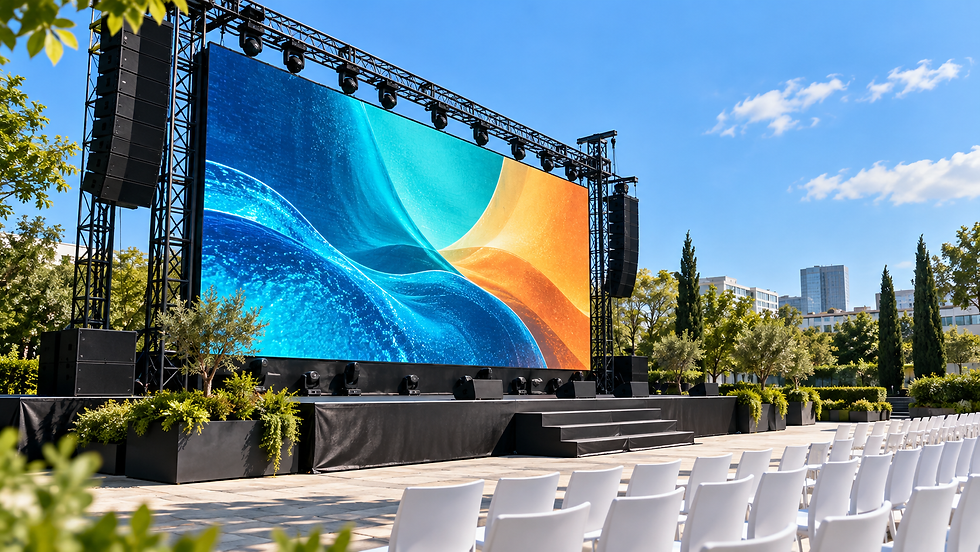
On stage, and for any image larger than 3×2 m, choose an LED screen: the image has no lines, it is brighter and it can take any size or shape.
An LCD video wall wins when people stand 1–2 m away, read small text and the surface is small: reception desks, exhibition booths, networking areas, agenda boards.
What do we mean by “video wall”?
In Romania, “videowall” is used for two different things. Some people use it for any large screen, others only for LCD monitors tiled together.
When we compare an LED wall vs an LCD video wall, video wall means LCD monitors, usually 55 inch, mounted in a grid. LED wall means direct-view LED panels joined without lines between them. The full terminology (LED screen, video wall, LED wall) is covered in our separate article on the terms.
LED wall vs LCD video wall: which differences matter?
Criterion | LED screen | LCD video wall |
Lines between modules | None | Yes, 0.44 to 3.5 mm between monitors |
Brightness | 800–1,500 nits indoors, over 4,000 outdoors | 500–700 nits |
Sharpness up close | Good from 2–4 m, depending on pixel pitch | Very good from 1 m (a 55” Full HD panel equals a pitch of about 0.63 mm) |
Viewing angle | About 160° | Up to 178°, with lower contrast from the side |
Shapes | Flat, curved, cylinder, corner, custom shapes | Rectangle only |
Size increment | 0.5 m | One whole monitor, about 1.21×0.68 m |
Outdoor use | Yes, with IP65 panels | No |
Weight per m² | About 30 kg | About 20 kg |
The most visible difference is the lines. On a 3×3 video wall, a speaker’s face on the live camera feed is cut by 2 vertical and 2 horizontal lines. On a text slide, the lines run through the letters.

When should you choose an LED screen?
On the main stage, for presentations and live camera.
For any surface larger than 3×2 m. A video wall grows one whole monitor at a time, and the lines multiply.
When the room has daylight or strong stage lighting. At 500 nits, the image washes out fast.
When the shape is part of the set design: an arch, a cylinder, a 90° corner. That is what flexible LED screens and Creative LED are for.
Outdoors, where LCD has neither the brightness nor the protection it needs.
When should you choose an LCD video wall?
At reception and check-in, where people stand 1 m away and read room names.
At small exhibition booths, with software demos or fine print.
For the event agenda, displayed in the foyer.
For dashboards full of numbers that people read up close.
In all of these cases, the audience stands closer than the minimum viewing distance of a rental LED screen, and the surface is under 6 m².
Can I use both at the same event?
Yes, and it is the most common setup at large conferences. The LED screen sits on stage, and the monitors go in the foyer, in the breakout rooms and in front of the speaker as confidence monitors.
They all get their signal from the same video control room. Mobile Event works with Blackmagic ATEM switchers and Novastar processors, so the same slide appears in sync on the big screen and on the monitors. Details on our AV direction page.
What about video projection?
Projection is the third option, and it wins in 2 situations: a fully dark room, and very large or irregular surfaces where you map onto the architecture. With ambient light, the contrast of a projected image drops a lot. A 20,000-lumen projector on a 5 m wide screen gives 250–350 nits, less than an LCD video wall. The options are on our video projection page.
Frequently asked questions
Do video wall and LED wall mean the same thing?
Not always. In the industry, video wall usually means LCD monitors tiled together, and LED wall means a screen built from bezel-free LED panels. Many suppliers mix the terms, so ask for the exact panel type in the quote.
Why can you see lines on a video wall?
Because every LCD monitor has a bezel. On video wall models, the gap between 2 monitors is 0.44 to 3.5 mm. On an LED screen, the panels emit light right to the edge and join without a line.
Which is cheaper, an LCD video wall or an LED screen?
It depends on the size. For 2 to 4 monitors, the video wall usually costs less. As the surface grows and you need a stage, brightness or custom shapes, the LED screen becomes the practical option.
Can I put an LCD video wall on stage?
Yes, in a small room with the audience close by and controlled lighting. On a conference stage with more than 100 people, the lines and the low brightness show from the room and on the stream.
Sources
Updated: October 2026. Written by George Știrbei, Technical Director and founder of Mobile Event.


