


LED Screen vs Videowall vs LED Wall: What Is the Difference and When Do You Use Each?

Updated: 56 minutes ago
LED screen, videowall and LED wall describe roughly the same category of technology: a modular display for corporate events.
The difference is more about context and industry habit than about the technology. LED screen is the generic term.
Videowall describes the configuration (multiple coordinated screens).
LED wall is the commercial name agencies use for large stage configurations. Below I set out the terminology, when to use each one, and how Mobile Event delivers the whole range with 1,100 LED cabinets in inventory.
What is an LED screen?
An LED screen is a modular display built from interconnected cabinets of LED pixels. Each cabinet is a standalone unit that connects electrically and mechanically to others to form a screen of any size.
LED screen is the most generic term in the industry. It covers every type: fine pitch (P1.9, P2.6), standard pitch (P3.9, P4.8), indoor, outdoor, curved, flat, rigid or flexible.
Mobile Event runs 1,100 LED cabinets in inventory: 400 flexible FLEXX Xtra Series (P2.9 outdoor, IP65) plus 700 standard Creative LED P3.9.
That is part of the 300+ sqm LED inventory, configurable for any type of corporate event, from a 200 person conference to an outdoor festival with 20,000+.
What is a videowall?
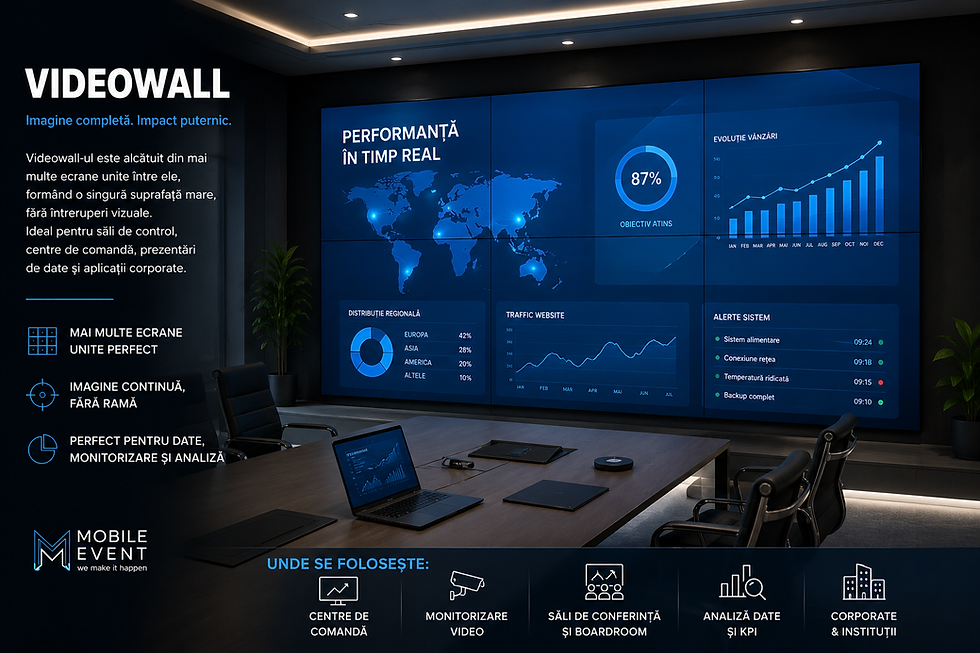
A videowall is a configuration of connected displays showing a single image or multi-source content.
In corporate events, videowall usually describes a large LED screen made of multiple cabinets coordinated by a central controller.
The term applies to any multi-screen setup: 2x2 LCD monitors in a corporate lobby, 6x3 LED cabinets on stage, an 8x4.5 m backdrop at a corporate show, or ceiling LED for an xR studio.
The key to a videowall is signal coordination.
Every screen shows synchronised content through a central controller. For LED: a Novastar system. For LCD videowall: a separate video wall processor.
Mobile Event runs 15 Novastar controllers and 12 Blackmagic ATEM switchers for any kind of multi-source videowall.
What is an LED wall?
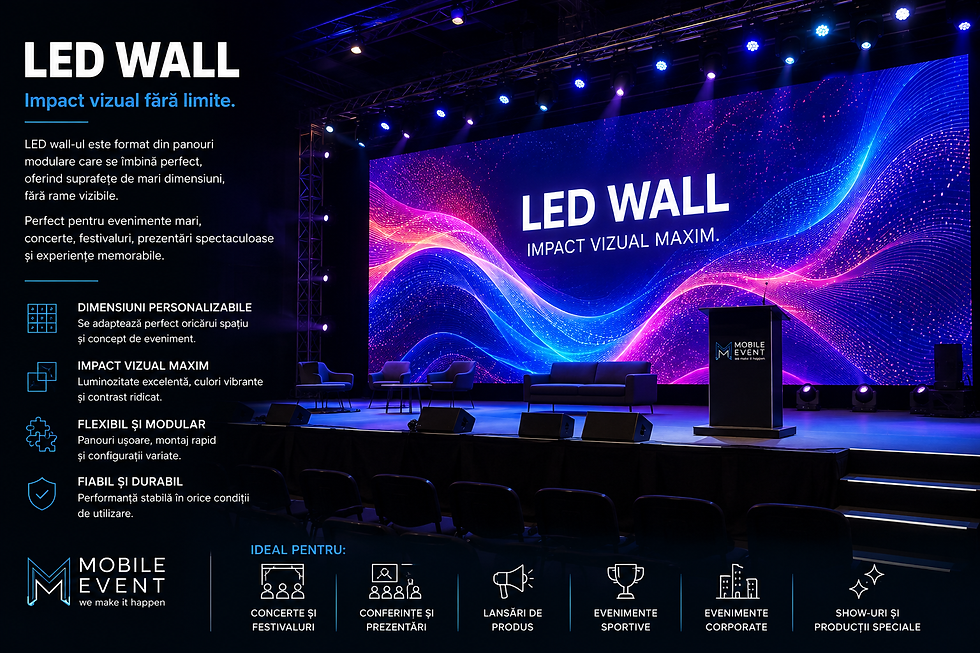
LED wall is the commercial name agencies and organisers often use for a large scale LED screen, typically for an event stage.
It is close to LED screen but stresses the wall-size dimension: a large configuration filling a stage backdrop. Usually 6 to 15 metres wide and 3 to 5 metres high.
The semantic difference from LED screen is the implied size. An LED screen can be any size (2x1 m is fine). An LED wall implies large, wall-size scale.
For configurations under 5 m wide, most professionals say LED screen rather than LED wall.
What is the practical difference between LED screen, videowall and LED wall?
LED screen and LED wall are the same technology and differ only in size. Videowall is a special case: it can be built from LED cabinets or from LCD monitors tiled together. The differences come down to:
Industry context: technical suppliers say LED screen, creative agencies say LED wall, AV directors say videowall.
When someone asks for a videowall, ask which panel type they have in mind: bezel-free LED or LCD monitors with visible bezels.
Implied scale: LED wall suggests large size (6 m+ wide). Videowall implies coordinated multi-screen. LED screen is neutral on size.
Exact technology: a videowall can also be LCD, rarely used for premium events because of the visible bezels. LED wall is exclusively self-emitting LED technology.
For a practical comparison of an LED screen and an LCD video wall (bezels, brightness, viewing distance), see LED wall vs LCD video wall: which one should you choose for your event?
A practical recommendation for the technical brief: use concrete dimensions instead of generic terms. A brief that says LED backdrop 8x4.5 m P3.9 is far clearer than we want an LED wall or we want a videowall.

When do you use a single LED screen and when a videowall?
A single zone LED screen is used where you have one main backdrop. Even small screens (2x1 m) have 8 to 16 connected cabinets, so technically they are multi-cabinet, but they run as a single zone.
A videowall (multiple coordinated zones) is needed for:
A corporate stage with a centre screen plus 2 side screens for side cam or delegate feeds: 3 LED zones coordinated through a switcher.
A corporate lobby with wayfinding across 4 synchronised LCD monitors.
A TV studio or xR virtual production with multiple screens for broadcast (270 degree curved wall plus ceiling).
The practical rule: one LED zone with unified content is an LED screen. Multiple zones connected through a switcher or video wall processor is a videowall.
When do you use an LED wall for corporate events?
An LED wall in the stage-size sense (6 m+ wide) suits:
Corporate galas with 800+ attendees: a 6 to 8 m wide LED backdrop for speakers and show. A typical Mobile Event configuration: 6x3.5 m Creative LED P3.9 (48 cabinets) for the stage.
Premium conferences with 1,500+ attendees: a large 8x4.5 m centre screen plus 2 delegate side screens. Total configuration: 180+ LED cabinets.
B2C product launches with a cinematic reveal: a 12x4 m panoramic backdrop (96 cabinets) for narrative content plus a 2.54 m diameter FLEXX Xtra cylinder (96 cabinets) for the central product reveal.
Outdoor festivals with a main stage: a 16x9 m LED wall (576 cabinets) plus IP65 rain-resistant side screens. Mobile Event has run setups like this at Romanian festivals since 2007.
xR studio or virtual production: a 270 degree curved LED backdrop (240 FLEXX Xtra cabinets) plus ceiling LED (192 Creative LED cabinets) for a complete virtual production environment compatible with 4K and 8K broadcast cameras.
What other terms are used in the industry?
LCD wall or monitor wall: multiple connected LCD televisions. Different from an LED wall, because LCD has visible bezels between screens (the black band at the edges) while LED is seamless.
For premium events, LED wall is always preferred.
Screen wall: a generic term for any videowall, LED or LCD. Rarely used in serious technical briefs.
Media wall: usually describes an interactive videowall or one with dynamic marketing content (retail displays, brand activations).
Digital signage: digital display for retail, outdoor advertising or wayfinding. Not necessarily for events. A different use case.
Video projection: a completely different alternative to LED. An image projected onto a passive screen from a projector, rather than a self-emitting surface.
Mobile Event runs both: 1,100 LED cabinets plus Panasonic 21K lumen projectors for video projection setups.
Which configuration do you pick for your event?
The choice between a single LED screen, a multi-screen videowall or a large LED wall comes down to 4 main variables:
1. Event scale. Under 300 attendees: a single 4 to 5 m LED screen. 500 to 1,500 attendees: a multi-screen videowall (centre plus sides). 1,500+ attendees: a large 8 m+ LED wall plus delegate screens for the far audience.
2. Type of content. Static (logo, simple slides): a single LED screen is enough. Multi-source (live cam plus slides plus synced video): a videowall with a Blackmagic ATEM switcher. Cinematic or choreographed show: a large LED wall with curated content and dedicated AV direction.
3. Budget. LCD videowall: cheapest, but with visible bezels. Standard LED P3.9 (Creative LED): mid budget, seamless image. Flexible LED P2.9 (FLEXX Xtra): premium, for curved shapes and creative configurations.
4. Venue. Small rooms with low ceilings: a single mobile LED screen on stands. Large rooms with rigging: an LED wall flown on truss. Outdoor: LED rated IP65, 3,500+ nits for direct sun.
How does Mobile Event deliver each of these configurations?
Mobile Event runs the full LED range, adapted to any scale and type of corporate event:
Standard LED screen (flat backdrop): 700 Creative LED P3.9 cabinets available for flat backdrops from 4 m to 16 m wide. IP65 for outdoor, brightness 4,000 to 5,500 nits.
Coordinated multi-screen videowall: custom configurations with 15 Novastar controllers plus 12 Blackmagic ATEM switchers. One control position for any combination of LED zones (centre, sides, delegate, ceiling).
Large scale LED wall: combined surface from the 1,100 cabinets, part of the 300+ sqm LED inventory. For outdoor festivals or premium launches with a 16x9 m backdrop or larger.
Flexible LED (FLEXX Xtra): 400 P2.9 cabinets for 1.27 m diameter cylinders, plus or minus 45 degree arcs, S shapes, domes and curved 3D facades. For immersive brand activations and xR studios.
Every configuration is delivered by the in-house Mobile Event crew with no subcontracting, a dedicated project manager from brief to debrief, 4 active ISO certifications (9001, 14001, 27001, 45001) and 19 years of activity (since 2007) across 1,500+ corporate events.
Frequently asked questions about LED terminology
Are LED wall and videowall the same thing?
Not always. Many people use the terms interchangeably for any large screen. Strictly speaking, LED wall means a screen built from bezel-free LED panels, and videowall usually means LCD monitors tiled together, with visible bezels between them. That is why you should ask for the exact panel type in the quote.
How many LED cabinets do you need for an 8m x 4.5m LED wall?
It depends on cabinet size. For the standard 500x500 mm cabinets Mobile Event uses: 8 m wide means 16 cabinets across, 4.5 m high means 9 cabinets up. That is 144 cabinets for a complete 8x4.5 m LED wall.
Is an LCD videowall cheaper than an LED one?
Yes, LCD costs less per square metre. It carries 2 drawbacks: visible bezels between screens, which break up unified content, and lower brightness, which does not suit rooms with a lot of ambient light. For premium B2B events, LED is always the recommended choice.
Can I combine an LED wall with an LCD videowall at the same event?
Yes, through a Blackmagic ATEM or Tricaster video switcher. A common setup: a main LED wall on stage for the speakers plus small LCD monitors for lobby wayfinding. AV direction coordinates both systems from a central controller.
Which term should I use in a technical brief for a supplier?
Use concrete dimensions instead of generic terms. A brief that says LED backdrop 8x4.5 m, P3.9 pitch, indoor is far clearer than we want an LED wall or we want a videowall. It removes ambiguity and gets you comparable quotes from different suppliers.
Mobile Event has delivered technical production for corporate events since 2007.
1,100 LED cabinets in inventory (flexible FLEXX Xtra plus Creative LED P3.9). 1,200+ pieces of audio, lighting and staging equipment. In-house crew, no subcontracting. 4 active ISO certifications.
